

The DRDP: 29 areas of your child's development
A guide for parents. First published Jan. 2017; last reviewed Oct. 2026.
What is the DRDP?
The DRDP (Desired Results Developmental Profile) is how early educators in California observe and describe a young child's development. The California Department of Education and WestEd developed it so educators can follow a child's developmental stage and share it with parents and other educators. Parents know their children by heart; the DRDP gives educators and families a shared way to talk about how a child is growing.
The official page for parents: desiredresults.us, resources for families.
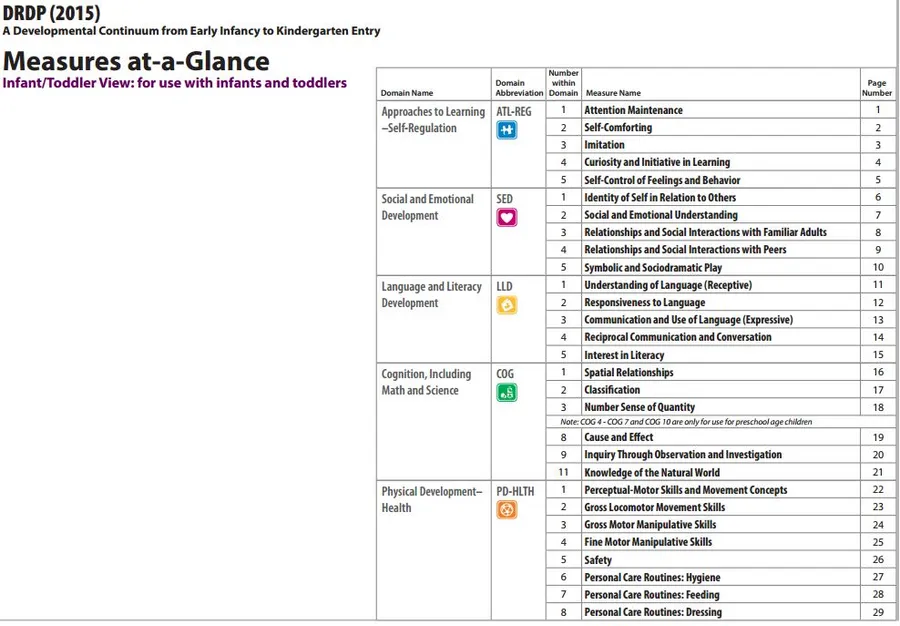
The 29 areas for infants and toddlers
The DRDP (2015) Infant/Toddler View looks at 29 areas (called measures) grouped in five domains:
- Approaches to Learning and Self-Regulation
- Social and Emotional Development
- Language and Literacy Development
- Cognition, including Math and Science
- Physical Development and Health
The chart above is from page 15 of the introduction to DRDP (2015): A Developmental Continuum from Early Infancy to Kindergarten Entry. You can download the full instrument from the California Department of Education: DRDP (2015) Infant/Toddler View (PDF).
Why we use it
Pyrena brought the DRDP into our program after a training hosted by WestEd. It helps parents see their child's development across the full range, and it helps each educator plan activities for the needs of different children.
Will my child need to take a test at this young age?
No. This is one of the most common questions from families who hear about the DRDP for the first time.
Children are natural learners. They are curious about everything: the moving objects in front of their eyes, the sounds around them, the movements of their own bodies. When they play, they are developing their senses and their bodies.
Our educators prepare a safe, fun environment where children experience the world for themselves, and observe their development with the DRDP while they play. No test, no stress, and no extra effort for children: they learn at their own pace and in their own style, and enjoy their infancy and childhood.
How do parents hear about it?
On top of the daily report, we hold parent-teacher conferences twice a year, and the child's DRDP is part of that conversation. We share the strengths and challenges we see, and parents share their own observations or concerns. Good communication is the key to a successful partnership between a family and its child care program, and we use the feedback to improve the program.
Wondering how this connects to kindergarten? See our parent guide to TK and school readiness.